

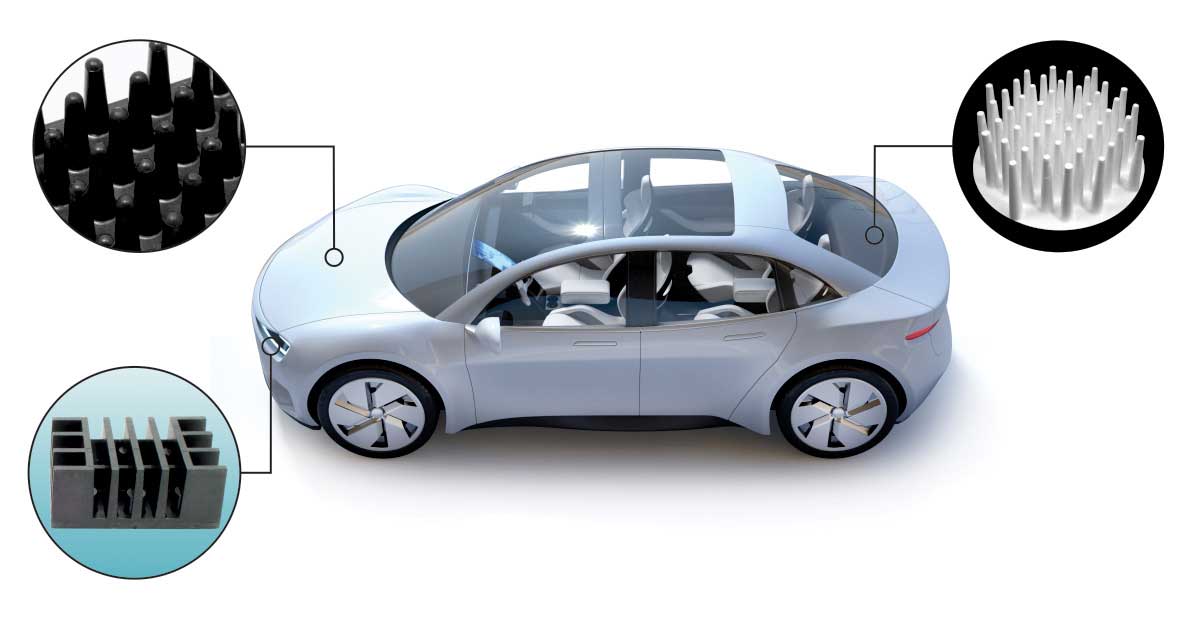
Advanced Thermoplastics for Electric and Sustainable Mobility
The transition to electric and hybrid mobility is profoundly transforming the automotive sector.
In addition to replacing combustion engines with electrified systems, future vehicles integrate autonomous driving technologies, advanced sensors, and high-power density electronic modules.
In this scenario, there is a growing need for lightweight materials capable of effectively managing heat while maintaining high mechanical strength and chemical resistance.
This is where thermoplastic compounds for thermal management come into play, developed to replace metals and alloys in structural and functional applications.
LATICONTHER MI: Thermoplastic Compounds for Thermal Management in the Automotive Sector
The LATICONTHER MI line, designed by LATI Industria Termoplastici, represents a new generation of structural thermally conductive materials for the needs of modern automotive.
These high-performance thermoplastic compounds combine:
- High thermal conductivity, to promote heat dissipation from electronic modules and power components;
- Superior mechanical strength, even in critical environments;
- Chemical compatibility with lubricants, coolants, and other engine fluids;
- Low density, to contribute to the overall weight reduction of the vehicle.
Composition and Properties of LATICONTHER MI Compounds
LATICONTHER MI compounds are based on a PA66 matrix reinforced with 35% glass fiber, stabilized to ensure consistent performance over time even in the presence of high temperatures and aggressive chemical agents.
Material structure
- Polymer matrix: Thermally and chemically stabilized PA66
- Reinforcement: 35% glass fiber
- Thermally conductive additives: selected to maximize heat flow while maintaining mechanical integrity
- Density: <1.6 g/cm³
The result is a material that dissipates up to 10 times more heat compared to traditional reinforced compounds, without sacrificing stiffness or tensile strength.
Performance of LATICONTHER MI01 and MI02 Grades
| Property | LATICONTHER MI01 | LATICONTHER MI02 |
| Technical objective | Maximize mechanical strength | Optimize thermal conductivity |
| Thermal conductivity (W/mK) | ~2 (longitudinal) | ~5 (longitudinal) / ~1 (transverse) |
| Tensile strength (MPa) | ~150 | ~120 |
| Elastic modulus (GPa) | 13 | 15 |
| Density (g/cm³) | <1.6 | <1.6 |
| Typical applications | Structural supports, brackets, housings | Heat sinks, integrated thermal components |
The properties of both materials allow for optimal thermal management of electronic systems and power modules (inverters, converters, sensors), combined with structural robustness and fatigue resistance.
Advantages over Metallic Solutions
The thermoplastic compounds for automotive thermal management offer numerous advantages over traditional metals (aluminum, steel):
| Aspect | Metal | Thermoplastic compound |
| Weight | High | Reduced (-50%) |
| Workability | Requires mechanical processing | Direct injection molding |
| Thermal conductivity | High | Medium-high (up to 5 W/mK) |
| Electrical insulation | Poor | Excellent |
| Chemical resistance | Limited to surface treatments | Intrinsic |
| Recyclability | Medium | High (thermoplastic) |
These characteristics make the compounds ideal for multifunctional structural components, where thermal management, rigidity, and electrical insulation must coexist.
Applications in Electric and Hybrid Vehicles
The LATICONTHER MI compounds are suitable for a wide range of applications in the electric mobility sector:
- Cooling systems for batteries and electronic modules
- Structural supports for electric motors and inverters
- Power housings for converters and control units
- Dissipative plates and components for integrated thermal management
The combination of lightweight, thermal performance, and mechanical stability makes them a strategic choice for the design of new generation vehicles.
Innovation and Continuous Development
In addition to
- Improved chemical resistance;
- Greater dimensional stability at high temperatures;
- Optimization of processability for high-volume molding.
Conclusion
Discover how thermoplastic compounds for automotive thermal management can improve the efficiency and sustainability of your projects.
Visit www.lati.com to learn more about LATICONTHER MI solutions and request dedicated technical support.
FAQ – Thermoplastic Compounds for Automotive Thermal Management
- What advantages do thermoplastic compounds offer compared to metals?
They allow for weight reduction, simplify production, and maintain high thermal dissipation at lower costs. - Can LATICONTHER MI materials replace aluminum components?
Yes, in many applications with medium-high loads, ensuring rigidity, electrical insulation, and thermal conductivity up to 5 W/mK. - Are they compatible with automotive fluids and chemical agents?
Yes, the stabilized PA66 resists lubricants, coolants, and fuels, maintaining mechanical properties over time.
 Accessibility Statement