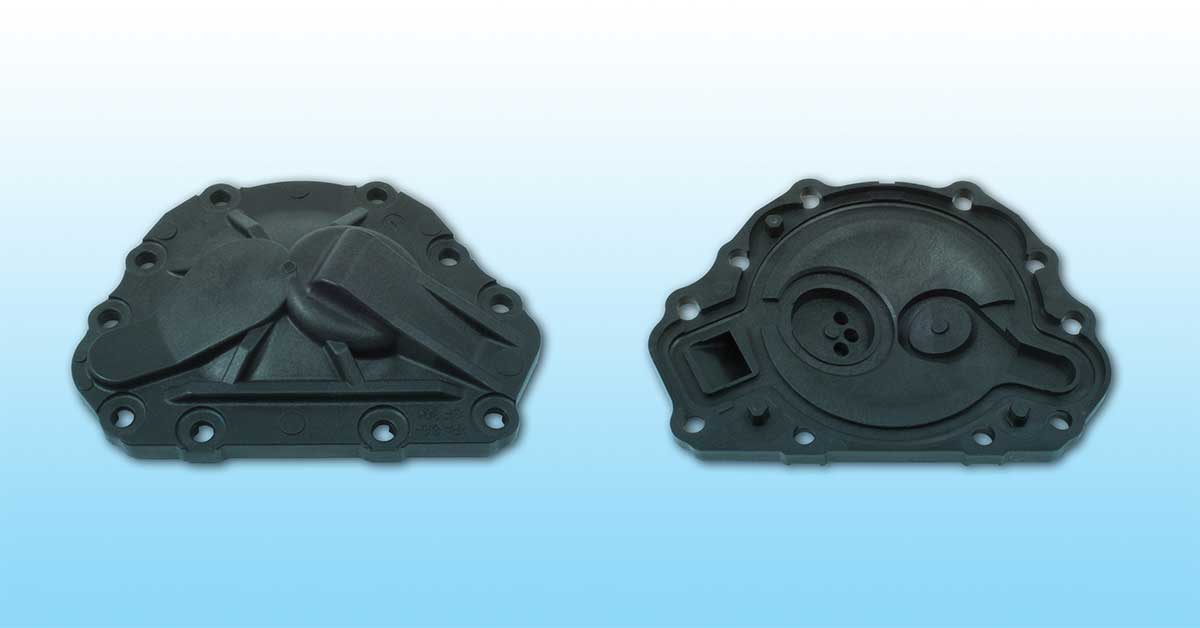
Reduce Weight without Compromising Performance
Weight reduction is a priority in the automotive industry, both to improve energy efficiency and reduce emissions. This also applies to under-hood components, such as vacuum pumps (EPV pump) in the brake oil circuit, which are subject to mechanical loads, high temperatures, and chemically aggressive environments.
Replacing Metal with a Thermoplastic Compound
A well-known multinational company in the sector has developed an innovative project: replacing metal in a vacuum pump housing, maintaining mechanical functionality while introducing thermal conductivity capabilities.
The component requires:
- Dimensional stability in a temperature range from -40°C to +120°C,
- Structural mechanical strength,
- High thermal conductivity to support heat dissipation in the circuit.
LATICONTHER 62 GRG/500: Meeting Technical Requirements
LATI has developed a custom
- 50% graphite → for a thermal conductivity of 15 W/mK,
- Short glass fibers → for mechanical reinforcement and dimensional stability.
Main characteristics:
| Property | Value / Advantage |
| Thermal conductivity | 15 W/mK |
| Operating temperature | -40°C to +120°C |
| Stiffness and strength | High due to glass reinforcement |
| Moldability | Optimal even for complex geometries |
| Chemical resistance | Suitable for aggressive environments |
The compound has successfully passed operational fatigue tests, a key criterion for metal replacement projects in the automotive sector.
Economic and Environmental Benefits
Beyond technical performance, the new technopolymer housing enables:
- Reduced production costs,
- Recyclability of processing waste,
- Compliance with environmental regulations (RoHS, REACH).
This makes the thermally conductive compound for automotive a sustainable and economically competitive solution.
FAQ
Why replace aluminum with a thermally conductive compound?
To reduce weight and costs while maintaining good mechanical performance and thermal dissipation.
Is a PA6-based compound suitable for high temperatures?
Yes, when properly reinforced and additivated, it can operate in typical under-hood temperature ranges.
Can compound components withstand mechanical fatigue over time?
Yes, as demonstrated by the tests passed by the vacuum pump housing described.
Contact Us
Are you evaluating a metal replacement project in automotive?
The conductive thermoplastic compounds represent a technical and sustainable solution, ready for the challenges of electric mobility and lightweight transportation.
Contact us for a customized application study.
 Accessibility Statement