

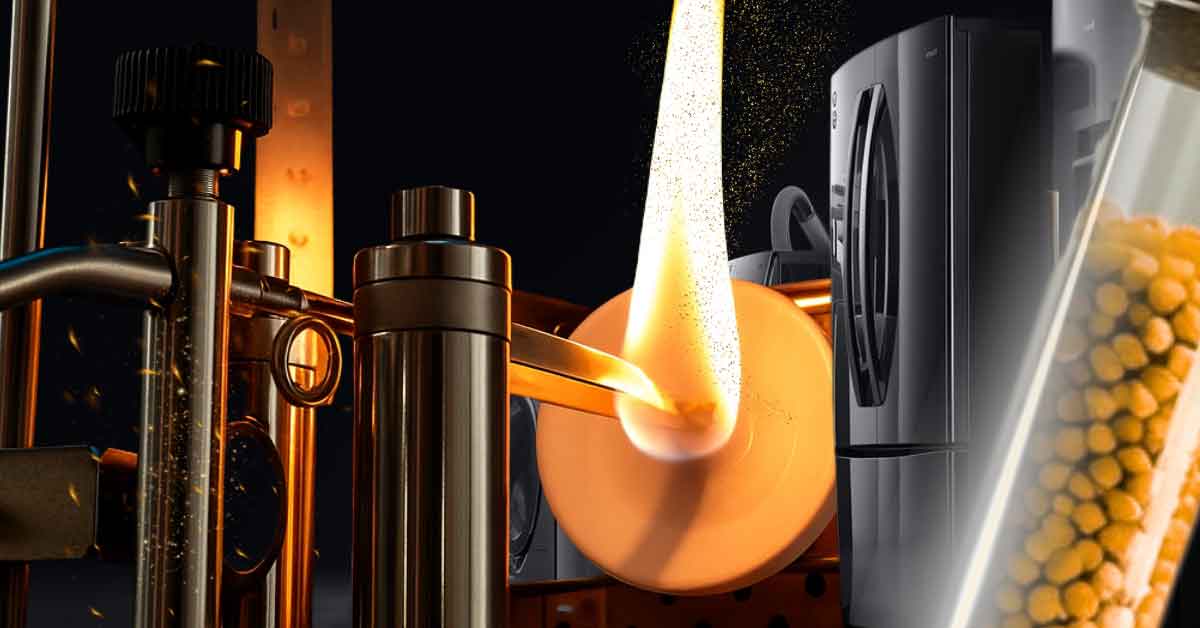
The safety of electrical and electronic components in household appliances is one of the main challenges for designers and quality managers. The IEC 60335-1 standard regulates these aspects, establishing rigorous criteria to ensure that the plastics used do not pose a fire risk, even under conditions of prolonged use or in the absence of supervision.
Among the most relevant parameters, the GWIT (Glow Wire Ignition Temperature) and the use of halogen-free flame-retardant materials stand out.
Safety in Household Appliances: What the IEC 60335-1 Standard Requires
Household appliances, especially those intended to operate unattended, must demonstrate resistance to ignition and flame propagation even in the presence of internal electrical components that can overheat. The IEC 60335-1 standard therefore imposes glow wire resistance tests, in particular:
- GWIT ≥ 775 °C for many internal applications
- GWFI (Glow Wire Flammability Index) up to 960 °C for materials subject to extreme thermal stress
These requirements necessitate the selection of high-performance thermoplastic materials, even on reduced thicknesses, without compromising safety and functional integrity.
Why a Halogen-Free Material with High Performance is Needed
While until a few years ago the use of halogenated additives was considered the standard to ensure flame retardancy and flame stability, today the scenario has changed. The restrictions introduced by RoHS and REACH regulations, combined with the growing attention to smoke safety in case of fire, make the use of halogen-free materials preferable (and sometimes mandatory).
In parallel, trends in component miniaturization and thickness reduction require materials capable of offering UL94 V0 on thin walls, without losing essential mechanical and thermal characteristics.
LATI Compounds for High GWIT: What They Offer Differently
To meet these requirements, LATI has developed a series of high-performance halogen-free flame-retardant compounds, marked with the suffix V0HF1. These materials are free of both halogens and red phosphorus, ensuring maximum regulatory and environmental compatibility.
Among these, LATAMID 66 H2 G/25-V0HF1X stands out, a reinforced PA66-based compound that offers:
- UL94 V0 certification at 0.4 mm, where the standard usually stops at 0.75 mm
- Good processability and dimensional stability
- Adaptability to critical components such as overmoldings, connectors and separators in appliance devices
[Download the technical data sheet for LATAMID 66 H2 G/25-V0HF1X]
Glow Wire Performance: Exceeding 775 °C
For applications requiring even higher performance in terms of GWIT, LATI offers:
- LATAMID 66 H2 G/25-GWHF1 (PA66 based)
- LATAMID 6 H2 G/30-GWHF1 (PA6 based)
Both are in the process of certification for GWIT of 825 °C at 1.5 mm thickness, well above the minimum regulatory requirement. These grades are designed for components subject to severe thermal conditions and for OEMs aiming for certified and robust long-term safety.
[Download the technical data sheet for LATAMID 66 H2 G/25-GWHF1]
[Download the technical data sheet for LATAMID 6 H2 G/30-GWHF1]
Conclusion: how to Select the Safest Compound
Choosing the most suitable material for appliance applications today requires a balance between:
- Flame resistance (UL94 V0)
- Glow wire performance (GWIT, GWFI)
- Absence of critical substances (halogen-free, PFAS-free)
- Adaptability to complex geometries and thin walls
LATI’s V0HF1 compounds represent the concrete response to these needs, with technically advanced formulations that comply with the most restrictive directives. For projects requiring maximum safety, LATI offers not only the materials but also comprehensive technical support during the selection and design phase.
FAQ – Halogen-free Flame-Retardant Materials and Safety in Household Appliances
What Does GWIT Mean and why is it Important for the Safety of Household Appliances?
GWIT (Glow Wire Ignition Temperature) indicates the minimum temperature at which a plastic material ignites when subjected to a glowing wire. In the design of components for household appliances, a GWIT ≥ 775 °C is fundamental to comply with the IEC 60335-1 standard, which ensures the safety of devices in case of overheating or short circuit.
What is the Difference between GWIT and GWFI in Glow Wire Resistance Tests?
GWIT (Glow Wire Ignition Temperature) measures the material’s ability to not ignite, while GWFI (Glow Wire Flammability Index) evaluates its self-extinguishing properties once it has ignited. Both parameters are required by the IEC 60335-1 standard to ensure that plastics used in electrical appliances do not pose a fire risk.
Why Choose Halogen-Free Plastic Materials in Household Appliances?
Halogen-free materials do not contain halogens (such as chlorine or bromine) and therefore, in case of fire, do not release toxic or corrosive fumes. Moreover, they comply with the increasingly stringent
What are the Advantages of LATI V0HF1 Compounds for Appliance Applications?
LATI V0HF1 compounds combine UL94 V0 flame retardancy even on thin walls (down to 0.4 mm) with high GWIT and absence of halogens or red phosphorus. They offer excellent processability and dimensional stability, making them ideal for connectors, supports, overmoldings, and electrical components subjected to thermal stress.
How to Choose the most Suitable Plastic Material to Comply with IEC 60335-1?
To ensure compliance with IEC 60335-1, it is necessary to select materials that combine UL94 V0, GWIT ≥ 775 °C (or higher), GWFI up to 960 °C and halogen-free and PFAS-free formulations. LATI supports designers and OEMs in the technical and regulatory evaluation of the most suitable compound, providing technical data sheets and customized application assistance.
Contact us to receive technical data sheets, certification data, and assistance in choosing the most suitable compound for your needs.
 Accessibility Statement