The Revolution of Thermally Conductive Compounds in LED Lighting
The introduction of thermally conductive compounds in the world of LED lighting is now well-established, and LATI has played a crucial role in this process thanks to over twenty years of experience in developing high-performance materials.
Over time, design has evolved: from the initial experiments of replacing aluminum heat sinks to increasingly sophisticated integrated solutions capable of addressing challenges related to both light output and usage environments.
Today, thanks to LATICONTHER compounds, it is possible to create thermally conductive housings and heat exchangers in technopolymer for LED lamps with performance comparable to metals, but with advantages in terms of lightness, sustainability, and design.
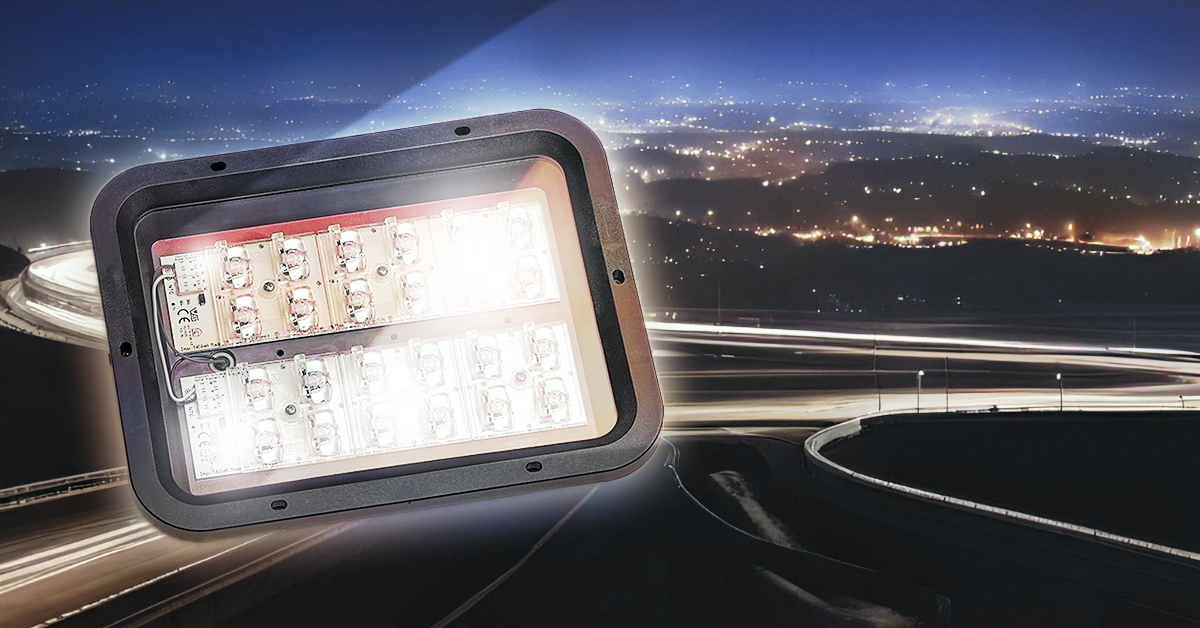
A concrete example is the new “Brave” line by Vossloh Schwabe, a leading German company in lighting technology, which has chosen LATI for the development of its replacement kits intended for lighting streets, tunnels, industrial plants, and public areas.
Brave Solutions with LATICONTHER: Power, Efficiency, and Compactness
The Brave replacement kits house 12 or 24 LEDs inside an enclosure made of LATICONTHER 62 GR/50, sealed with a glass plate that ensures IP66 protection against dust and water.
Main features:
-
Electrical power up to 40 W
-
Luminous flux up to 7,000 lumens
-
Compact dimensions: 231.6 x 182 mm
-
Optimal thermal dissipation thanks to the radiating surface in technopolymer
The dissipation system operates in natural convection, without the need for forced ventilation or cooling fins.
This configuration ensures optimal thermal management of the LEDs even in challenging environments, such as tunnels or industrial warehouses, where high temperatures and chemically aggressive atmospheres combine.
Collaboration and Innovation: Vossloh Schwabe and LATI
The collaboration between Vossloh Schwabe and LATI is not new: it dates back to 2011, when graphite-filled LATICONTHER compounds were successfully introduced in low-power LED applications, replacing aluminum in recessed light sources.
Since then, the partnership has continued to evolve, combining lighting technology expertise and research on thermally conductive materials to offer increasingly high-performing and sustainable solutions.
LATICONTHER: Performance, Lightness, and Sustainability
LATICONTHER compounds are born from LATI’s experience in hundreds of application cases, aiming to find the best balance between thermal conductivity, electrical insulation, and mechanical strength.
In the case of Brave headlights, LATICONTHER 62 GR/50 has ensured:
-
High impact resistance (certification IK09, 10-joule impact)
-
Excellent dimensional and thermal stability
-
Reduced density (approximately 1.5 g/cc)
-
Lower carbon footprint compared to metals
These features make LATICONTHER a technically winning and sustainable choice, in line with the demands of designers and companies seeking energy efficiency, weight reduction, and low environmental impact.
The topic of sustainability of thermally conductive compounds was also explored during a LATI webinar dedicated to the performance and lifecycle of materials.
Q&A – Frequently Asked Questions
Why Choose LATICONTHER over Aluminum in LEDs?
Because it ensures equivalent thermal dissipation, but with reduced weight, greater design freedom, and corrosion resistance.
Can LATICONTHER be Used in Critical Environments?
Yes, it is suitable for high temperatures and chemically aggressive environments, such as tunnels or industrial plants.
Is it a Sustainable Material?
Yes. LATICONTHER 62 GR/50 has lower density than metals and a reduced carbon footprint, offering high-performance and environmentally friendly solutions.
What are the Main Applications?
Heat sinks, LED housings, components for power electronics, and passive cooling systems.
 Accessibility Statement