

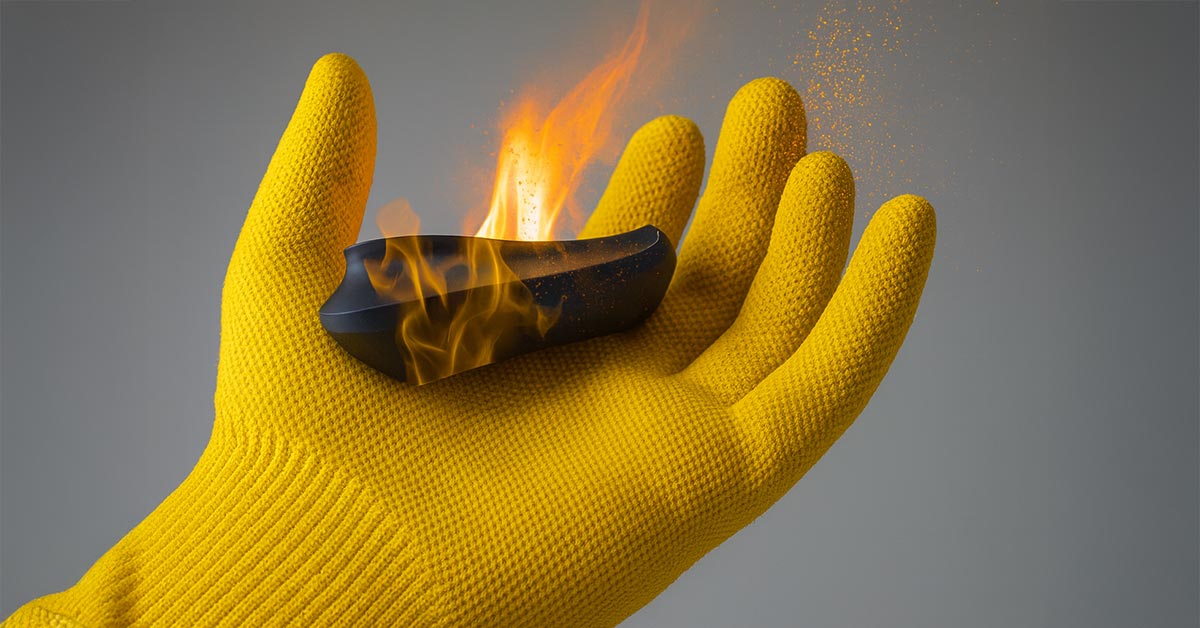
From UL94 Classification to Glow Wire Test and Thermal Indices: Discover the Regulations Governing Polymer Flame Resistance and Their Impact on Industrial Applications
If you’re reading this article, you probably have two needs: making your products flame-retardant, but don’t know where to start or which supplier to choose, or discovering which tests are performed to certify the flame resistance of plastic materials.
Polymers are widely used in household appliances, automotive, and consumer electronics, and their reaction to fire is a crucial safety parameter. To verify their suitability for use, specific regulations are employed, including UL94, Glow Wire Test (GWT), and thermal index (RTI).
Let’s examine in detail how they work and why they are fundamental for your products.
UL94: the Reference Standard for Flame Resistance
The UL94 is the main standard for evaluating the flammability of plastic materials. Developed by Underwriters Laboratories (UL), it classifies polymers based on their ability to resist flame and prevent fire propagation.
UL94 Classification: From V-0 to HB Rating
Tests are performed on specimens of varying thicknesses, based on the geometry of the part to be certified. The results are divided into four main categories:
- V-0: maximum resistance, with rapid extinguishing and no incandescent dripping.
- V-1: good resistance, with rapid extinguishing but possibility of incandescent drops.
- V-2: moderate resistance, with molten dripping that may ignite other materials.
- HB: the material is combustible and does not prevent flame propagation.
This classification is essential to determine if a polymer is suitable for critical sectors such as electronics and electrical engineering.
Glow Wire Test (GWT): the Test for Appliances and Beyond
In the appliance sector, where devices operate even without supervision, flame safety is fundamental.
This is where the Glow Wire Test (GWT) comes in, a standardized test that simulates an electrical short circuit, evaluating the plastic material’s reaction when it comes into contact with an incandescent metal wire.
Glow Wire Test Parameters
- Ignition temperature: the threshold at which the material ignites.
- Extinction time: the time needed for the polymer to self-extinguish.
- Flame propagation: the material’s ability to prevent fire spread.
Passing the glow wire resistance tests is often required for materials intended for electric motors, switches, connectors, and high-voltage components.
At LATI, we design materials with advanced performance in flame retardancy tests. If you need a custom polymer for your application, we’re here to help.
The Importance of Thermal Index Measurements
Another key factor in polymer selection is long-term thermal stability.
The thermal indices indicate the maximum temperature at which a plastic material can operate continuously before it begins to lose a significant percentage of its mechanical, electrical, or flame resistance properties.
Why is the Thermal Index so Important?
- It determines the material’s durability under prolonged use conditions and therefore the application’s life expectancy.
- It helps in selecting polymers for extreme environments subject to high temperatures.
- It prevents premature failures in electronic and electromechanical products.
Now you know everything behind the safety of flame-retardant materials. As you’ve seen, polymers intended for high-risk sectors undergo rigorous testing before being marketed.
At LATI, we are experts in flame-retardant materials, including those based on mechanical and chemical recycling. Our solutions ensure safety and regulatory compliance, perfectly adapting to your products’ needs.
Why not submit your project to us? Write to us here to receive personalized consultation with our materials technicians.
 Accessibility Statement